When Will the South Rise Again and Secceed

32e. The S Secedes
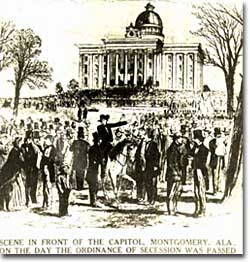
Crowds gathered in front end of the Capitol edifice in Montgomery, Alabama, the day that the secession bill was passed.
The force of events moved very quickly upon the ballot of Lincoln. Due south Carolina acted first, calling for a convention to secede from the Spousal relationship. Country by state, conventions were held, and the Confederacy was formed.
Within three months of Lincoln'due south ballot, 7 states had seceded from the Marriage. Merely every bit Springfield, Illinois historic the ballot of its favorite son to the Presidency on Nov 7, and so did Charleston, South Carolina, which did non cast a single vote for him. It knew that the election meant the formation of a new nation. The Charleston Mercury said, "The tea has been thrown overboard, the revolution of 1860 has been initiated."
Due south Carolina Ordinance of Secession
 Nosotros, the people of the State of South Carolina, in convention assembled, do declare and ordain, and it is hereby declared and ordained, That the ordinance adopted by us in convention on the twenty-tertiary day of May, in the twelvemonth of our Lord m seven hundred and fourscore-eight, whereby the Constitution of the Us was ratified, and likewise all acts and parts of acts of the Full general Assembly of this State ratifying amendments of the said Constitution, are hereby repealed; and that the marriage now subsisting between South Carolina and other States, nether the name of the "U.s.a. of America," is hereby dissolved.
Done at Charleston the twentieth day of December, in the yr of our Lord 1 chiliad eight hundred and sixty.
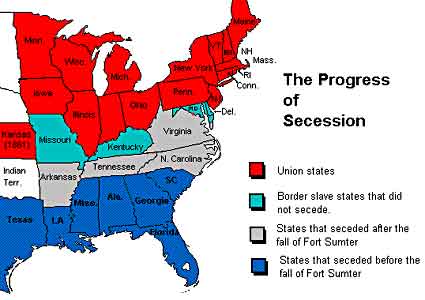
This map shows usa that seceded from the Union before the autumn of Fort Sumter, those that seceded subsequently, the slave states that did non secede, and the Union states.
Within a few days, the two U.s. Senators from South Carolina submitted their resignations. On Dec 20, 1860, by a vote of 169-0, the S Carolina legislature enacted an "ordinance" that "the matrimony now subsisting between South Carolina and other States, under the name of 'The Us,' is hereby dissolved." Equally Gist had hoped, Due south Carolina'due south action resulted in conventions in other southern states. Mississippi, Florida, Alabama, Georgia, Louisiana, and Texas all left the Wedlock past Feb one. On February 4, delegates from all these states except Texas met in Montgomery, Alabama, to create and staff a regime chosen the Confederate States of America. They elected President Jefferson Davis. The gauntlet was thrown. How would the North respond?
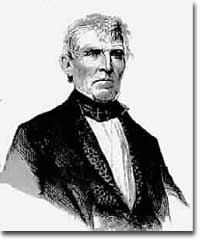
Senator Crittenden's two sons went on to serve equally generals on opposite sides of the Civil State of war.
A few final ditch efforts were made to stop the crisis through Ramble subpoena. Senator John Hashemite kingdom of jordan Crittenden proposed to amend the Constitution to extend the old 36°thirty' line to the Pacific. All territory Due north of the line would be forever free, and all territory south of the line would receive federal protection for slavery. Republicans refused to support this measure.
On March two, 1861, two days earlier Lincoln'southward inauguration, the 36th Congress passed the Corwin Amendment and submitted information technology to the states for ratification as an amendment to the Constitution. Senator William H. Seward of New York introduced the amendment in the Senate and Representative Thomas Corwin of Ohio introduced it in the House of Representatives. The text of the proposed amendment is equally follows:
"No amendment shall be fabricated to the Constitution which will qualify or give to Congress the power to abolish or interfere, within any State, with the domestic institutions thereof, including that of persons held to labor or service past the laws of said Land."
Note that, much similar the rest of the language in the Constitution prior to the Ceremonious War, the proposed amendment never uses the give-and-take "slavery," instead employing the euphemisms "domestic institutions" and "persons held to labor or service." The proposed amendment was designed to reassure the seceding slave states that the federal authorities would not interfere with their "peculiar institution." If information technology had passed, it would have rendered unconstitutional whatsoever subsequent amendments restricting slavery, such as the 13th Amendment, which outlawed slavery throughout the nation. The Corwin Amendment passed the state legislatures in Ohio, Kentucky, Rhode Island and Maryland. Even Lincoln'southward own state of Illinois passed it, though the lawmakers who voted for information technology in Illinois were not really the elected legislators but were delegates to a country ramble convention.
Lincoln supported the Amendment, specifically mentioning it in his first countdown address:
"I understand a proposed amendment to the Constitution — which amendment, however, I have not seen — has passed Congress, to the event that the Federal Government shall never interfere with the domestic institutions of the States, including that of persons held to service ... holding such a provision to now be implied constitutional law, I accept no objection to its being made limited and irrevocable. "
The subpoena failed to go the required approval of 3/4 of all land legislatures for a Ramble Amendment, largely because many of the southern slave states had already seceded and did not vote on information technology.
What was the President doing during all this furor? Abraham Lincoln would non be inaugurated until March 4. James Buchanan presided over the exodus from the Union. Although he thought secession to be illegal, he constitute using the army in this case to exist unconstitutional. Both regions awaited the arrival of President Lincoln and wondered anxiously what he would do.
Source: https://www.ushistory.org/us/32e.asp
0 Response to "When Will the South Rise Again and Secceed"
Post a Comment